Why your choice of native app vs browser tool actually matters
Your team already has a way to get things done. It might be messy spreadsheets, a homegrown Access thing that only one person understands, or a browser tool someone’s cousin hacked together.
Then the conversation starts: “Should we get a native app or just build a browser tool?”
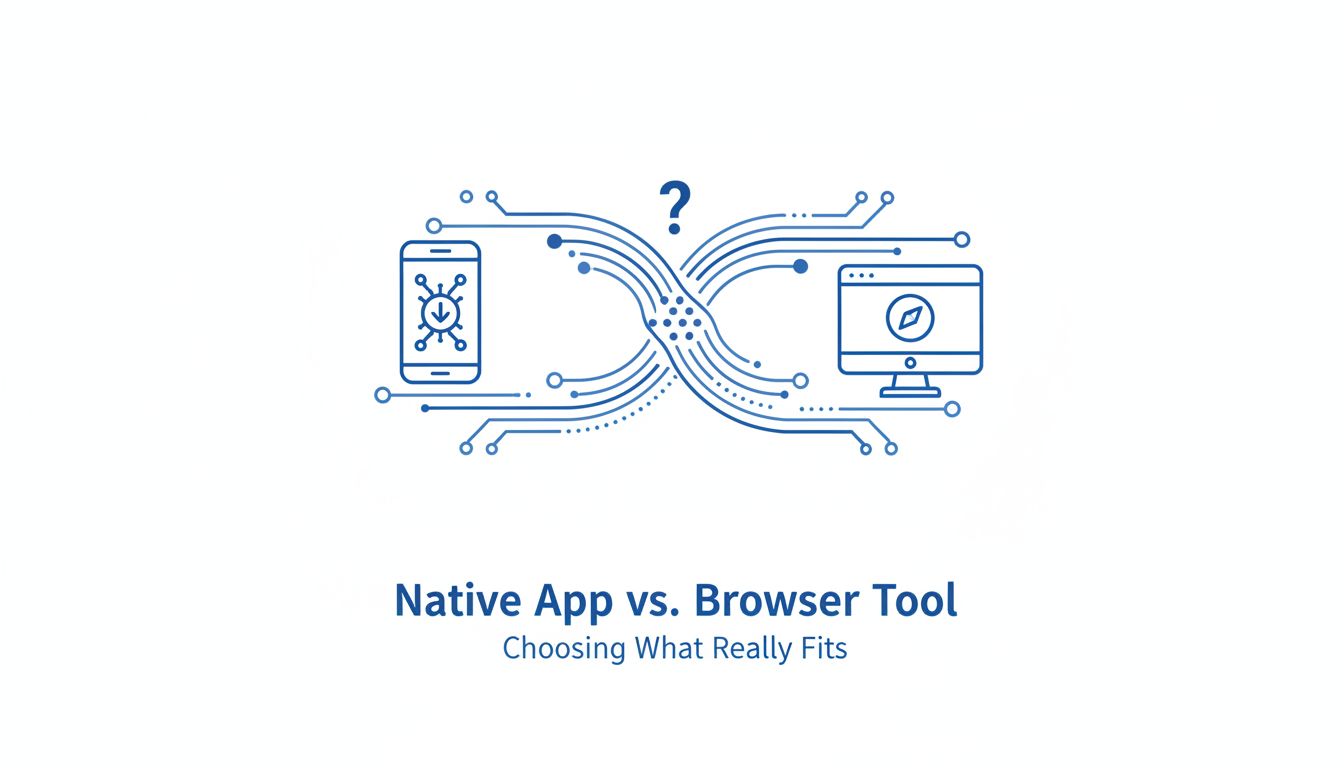
On paper, native app vs browser tool sounds like a technical choice. Mac and Windows vs Chrome and Edge. But for a small team, it quietly decides something bigger.
It decides how fast your people can think, how many mistakes they make, and how it feels to sit in front of that screen every day.
How tool shape quietly changes team behavior
Imagine two versions of the same internal system. Same data. Same people. Same company.
In one version, it is a native desktop app right on their Mac or Windows machine. It launches from the dock or taskbar. It feels like Excel or Figma. Keyboard shortcuts fly. It is smooth when you drag, type, or scrub through large data.
People tend to live inside it. They alt-tab into it constantly. It becomes “the control room.”
In the other version, it is a browser tool. One of 17 tabs. It runs inside Chrome or Edge. Quick to open, easy to share, always a URL away.
People usually dip in and out. Check something. Update a field. Close the tab. Back to email or Slack.
Neither is “better” in a vacuum. But each nudges behavior in a different direction.
Native apps encourage deep, focused work and “this is my main workspace.” Browser tools encourage flexible, collaborative, “let me just check this” usage.
When you pick one, you are not just picking tech. You are choosing what your work feels like.
What’s at stake for speed, quality, and morale
If your team spends 4 hours a day in a clunky internal tool, that is not just a minor annoyance. That is the emotional soundtrack of their job.
A sluggish browser grid that chokes on large records will quietly train people to avoid the tool. They keep their own private sheets. They double enter. Your data quality drops, and no one explicitly complains, because “this is just how it is.”
A native desktop tool that is fast but impossible to update, and only works for 3 people on-site, can stall every improvement idea. “Can we add a new field?” “Not without breaking the installer.” So the process freezes around what was easy to code two years ago.
Speed, accuracy, and morale are all connected. They live in the gap between “what the workflow needs” and “what the tool makes easy.”
That gap is exactly where the native app vs browser tool decision plays out.
Vibingbase works with teams that feel that gap every day, even if they do not have the vocabulary for it yet. You do not need the jargon. You just need to recognize the pain.
What small teams really mean by a “native app” or a “browser tool”
If you talk to developers, they can go for 30 minutes on frameworks, runtimes, and deployment pipelines.
That is not what small teams actually mean when they say “we want a native app” or “we just need a browser tool.”
The simple version (without the jargon)
When people say “native desktop app”, they usually mean:
- It runs as its own program on Mac or Windows.
- It feels fast and responsive, even with lots of data.
- It looks and behaves like other desktop tools they trust.
- It keeps working even if the Wi Fi dies.
Think: Excel, Notion desktop, a custom operations console, a production scheduling tool.
When people say “browser tool”, they usually mean:
- You open it in Chrome, Edge, Safari, etc.
- There is a URL you can send to someone.
- It is easier to roll out to a new person. “Here is the link. Log in.”
- It works on whatever they are using that day, at the office or at home.
Think: internal dashboards, lightweight CRMs, admin panels, forms, task tracking.
So in practice, “native” usually signals depth and performance. “Browser” usually signals access and convenience.
Where the lines blur with modern frameworks
Here is where it gets interesting.
Modern frameworks blur the lines. A “native” app might actually be built with web tech inside a shell like Electron, Tauri, or similar. A browser tool might be installable as a PWA (progressive web app) and feel quite app-like.
A few consequences of this:
- Some “browser tools” can work offline or semi-offline.
- Some “native apps” are still at the mercy of the network, because all data is server side.
- You can have a desktop-like feel without going full traditional native (C++, Swift.NET, etc.).
This is actually good news for you.
It means you do not have to chase buzzwords like “true native” unless you have very specific performance or hardware needs.
You can focus on experience. How should it feel? Who needs to use it? What happens when Wi Fi is down, or someone is on a slow connection?
At Vibingbase, we often start the conversation exactly there. Describe a day in the life. The stack comes later.
The hidden costs you don’t see in the first demo
The first demo is usually a lie. Not on purpose, just by omission.
You see a small dataset. A simple workflow. A happy path.
What you do not see is how this thing behaves with real data, real mistakes, and real “we changed our mind again” moments.
Performance, offline work, and handling heavy data
If your team works with large data, performance is not a nice to have. It is the difference between “I can think while I work” and “I am waiting for a spinner.”
A few real world scenarios:
- A logistics team scrolling through 50,000 shipments, filtering, grouping, bulk editing.
- A production planner dragging dozens of jobs on a timeline, with real time clashes and constraints.
- A finance ops person reconciling thousands of transactions, matching, splitting, adjusting.
A slow browser interface turns into lag, delayed typing, weird freezes. People stop trusting it. They export to Excel, then reimport, which defeats the point of having a shared system.
A well built native desktop app can cache data locally, render complex views more smoothly, and stay usable even on weaker hardware.
[!NOTE] If your team already exports to Excel “to make it usable,” that is a strong signal you have a performance and UX gap, not just a data problem.
Offline matters too.
- Field staff in warehouses or on factory floors sometimes have patchy Wi Fi.
- Remote staff with spotty home internet still need to keep working.
- A desktop app that stores data locally and syncs later can keep them moving, instead of blocking them on a login screen.
Not every workflow needs this. But if yours does, it is not a detail. It is a core requirement.
Updates, support, and the risk of one-off solutions
A browser tool is usually centralized. Deploy once, everyone gets the new version. Issues are easier to patch quickly.
A traditional desktop app update might require:
- Installers for Mac and Windows.
- Rollout instructions or remote management.
- Dealing with people on old versions who “didn’t see the email.”
This is why so many internal desktop tools get stuck. The business changes, but the app does not.
There are ways to soften this. Auto updaters, managed deployments, self updating shells. But they need to be considered from day one.
The real cost is not the first version. It is every change request afterward.
If you hear yourself saying “we just need a tool that does X” as if X will never change, be careful. It will change.
Vibingbase sees this pattern all the time. Teams ask for a small fixed thing, but what they really need is something that can grow in a few predictable directions.
Security, access control, and compliance worries
Security is not just “is it in the cloud or not.”
You need to think about:
- Who can see what.
- Where the data lives.
- How people log in.
- What happens if a laptop goes missing.
Browser tools often plug into single sign on, central user management, and role based access more easily. They live inside infrastructure you already use.
Native apps can do that too, but it is extra plumbing. Without planning, you end up with:
- Local files with sensitive data.
- Sync hacks with shared folders.
- “Bob has the master copy” nightmares.
If you have compliance requirements, audits, or customer data in the mix, you want clear answers here.
[!IMPORTANT] Ask less “is this secure” and more “walk me through how access is controlled, logged, and revoked when someone leaves.”
How to decide: questions to match tech to your real workflow
You do not pick based on a feature checklist. You pick based on how your team works on a Tuesday afternoon under pressure.
So ask questions like:
- Where are people physically when they use this? Desk, floor, factory, client site, home.
- How big is the data they deal with, and how often does it change.
- What is the cost of being blocked for 30 minutes because the tool is slow or down.
- Who needs deep daily usage versus occasional access.
Signals you probably want a native desktop app
You likely lean native if several of these ring true:
- People spend most of their day inside this tool. It is not a side system. It is their main workspace.
- You handle heavy, complex data or visuals. Scheduling, large grids, timelines, maps, media, analytics with lots of interaction.
- You have unstable connectivity or critical workflows that cannot stop when the network hiccups.
- Performance is not just about comfort. It affects output, error rates, or safety.
- There are device specific integrations. Barcode scanners, file systems, specialized hardware, local printing quirks.
Imagine a manufacturing scheduling system where planners drag and drop jobs on multiple machines, see constraints live, and need to react fast to breakdowns.
A native app here can feel like a cockpit. Instant response. Keyboard driven. Clear, dense information without lag.
Could you build it in the browser? Possibly. But you would be fighting the environment all the way.
Signals a browser-based tool will serve you better
You likely lean browser if this sounds familiar:
- Many people need occasional access. Managers, finance, support, partners.
- A URL is your friend. You want “send them the link” to be the default support answer.
- Your workflows are structured but not visually heavy. Forms, approvals, lists, dashboards, CRUD style operations.
- You care a lot about fast rollout to new staff or locations.
- Central control and easy updates outweigh the need for extreme performance.
Think internal CRM, basic inventory, approval pipelines, customer support back office, lightweight project tracking.
If “works everywhere with minimal setup” beats “feels like a pro desktop tool,” the browser is your ally.
What to ask a vendor or developer before you commit
Whether you lean native app or browser tool, you want clarity early. Here are sharp questions that reveal a lot:
| Question | Why it matters |
|---|---|
| What happens if the internet drops for 30 minutes? | Exposes offline and sync behavior, not just uptime promises. |
| Show me how this performs with 50x the data you just demoed. | Surfaces real performance characteristics. |
| How are updates rolled out to users? | Reveals deployment complexity and maintenance overhead. |
| How do we control who can see or edit what? | Tests access control design. |
| What happens when we add a new location or team with slightly different rules? | Shows flexibility versus hard coded assumptions. |
| If we need to change a core workflow in 6 months, what does that look like? | Forces a conversation about evolution, not just version 1. |
[!TIP] Ask them to narrate tradeoffs. “If we choose browser here, what are we consciously giving up? If we choose native, what are we consciously taking on?”
You want someone who admits tradeoffs and explains them. If the answer is “there are no downsides,” that is a red flag.
Planning ahead so today’s choice doesn’t trap next year’s growth
The real risk is not picking wrong. The real risk is picking something that cannot change when you do.
Designing for change: new roles, new locations, new data
Your internal tool will not live in a vacuum.
You might:
- Expand to a second site with slightly different processes.
- Add a new role that needs a tailored view of the same data.
- Bring in new data feeds from another system.
- Tighten security or audit trails.
A smart design assumes this.
In practice, this looks like:
- Configurable roles and views, instead of one monolithic screen for everyone.
- A clean separation between data, logic, and interface, so you can change one without rewriting the whole thing.
- Deployment and update paths that do not require heroics every time you tweak something.
Here is the twist. Both native and browser tools can be either flexible or rigid. The tech choice does not magically solve this.
You can absolutely have a brittle browser tool and a well architected desktop app. Or the reverse.
So while you are debating native app vs browser tool, also ask: “Are we building this as a product that can evolve, or as a one off script in disguise?”
Vibingbase tends to push clients toward “treat it as a product,” even if only 20 people use it. Because internal products quietly become the backbone of how you operate.
A practical next step if you’re still on the fence
If you are not sure yet, do not start by choosing tech. Start by writing a one page story.
Describe a real person on your team. Give them a name. Walk through a full day of them using this tool.
- What are they trying to achieve?
- When are they in deep focus, and when are they multitasking?
- What goes wrong? Network, data, approvals, volume, confusion.
- What absolutely cannot be slow or flaky?
Then ask: In that story, does it feel more like:
- A “command center” app they live in all day on their desktop.
- Or a “shared portal” they hop into regularly from anywhere.
That instinct is more useful than debating frameworks.
Once you have that story, talk to someone who can map it to actual options. This is where a partner like Vibingbase fits. Bring the messy reality, not a sanitized spec. We can help you work out whether a native desktop tool, a browser based system, or a hybrid approach really fits how your team moves.
Your next step is simple. Write that one page story. Share it with whoever is building your tool. Make the native app vs browser tool decision in service of that person’s day, not in service of someone’s favorite technology.