Why this decision matters more than it looks
If you are comparing vibingbase vs bubble, you are already thinking more strategically than many first-time founders. You are not just asking how to get any software built, you are asking how to launch a desktop product without turning your company into a never-ending engineering project. The platform you pick will quietly decide how fast you can ship, how often you get stuck, and whether your margins survive contact with real customers. It feels like a tooling choice, but it behaves like a business model choice.
The real question is not “Which tool is more powerful?” but “Which tool lets me own my product with the least long-term pain?”
That is especially true when your first serious product is a desktop application. Most popular no-code tools grew up around web apps and internal tools. Desktop is different in ways that only show up once you have a few dozen paying users who expect installers, updates, and reliability on their actual machines. By then, migrating off the wrong stack feels like trying to swap engines mid-flight.
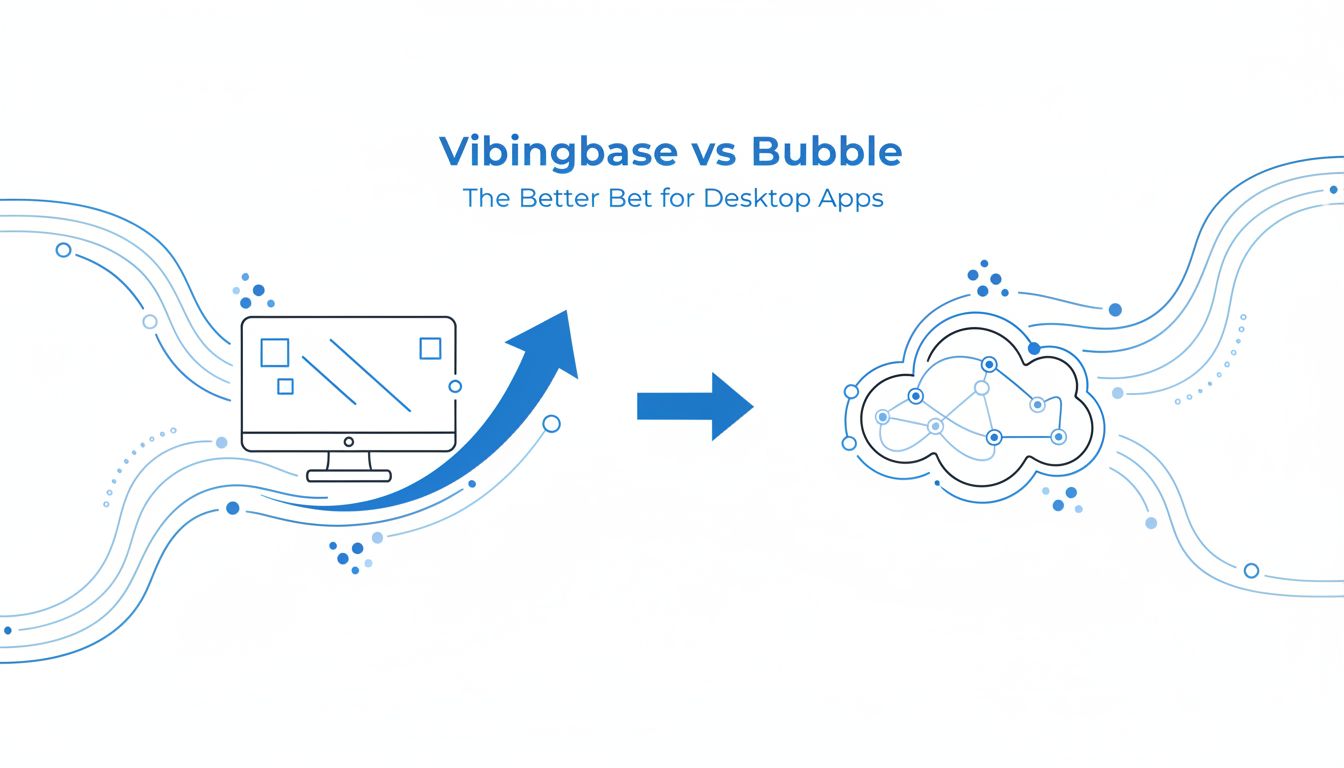
Framing this as vibingbase vs bubble is useful because each represents a different philosophy. Bubble is a mature, web-first no-code ecosystem that can be stretched toward desktop with wrappers and workarounds. Vibingbase positions itself on the opposite side of that spectrum, as a desktop-focused no-code environment where desktop packaging is the default outcome, not a hack on top. Understanding how those philosophies play out in practice will help you make a decision that survives year two, not just demo day.
The hidden costs of “just hiring a developer”
When founders hit friction with platforms, the fallback instinct is often simple: forget all this and just hire a developer. On paper, it sounds cleaner. Someone technical takes over, writes “real code,” and you go back to selling. In reality, that choice pushes you into a different kind of dependency that is just as real as platform lock-in, and much more expensive.
A single mid-level developer will often cost between 80,000 and 150,000 dollars per year once you include salary, benefits, and overhead. Freelancers on a project basis can look cheaper early, but scope creep, ongoing maintenance, and “quick changes” have a way of stacking invoices. You do not only buy development time, you buy an ongoing translation layer between your vision and a codebase that you cannot safely touch yourself.
You also inherit all the risk that the knowledge of how your product works lives in one or two brains. If they leave, get busy, or lose interest, you have an asset you do not really control. When you instead lean into a no-code platform that is aligned with your product type, you trade some technical freedom for a different set of advantages: predictable costs, a visual representation of your product logic you can understand, and the ability to ship changes yourself. The key is choosing a platform where that trade actually works in your favor for desktop software, not just for simple web forms.
What changes when desktop is your first serious product
Launching a desktop app as your first meaningful product is a different game from shipping a marketing site or even a lightweight SaaS. Users expect installers that do not trigger antivirus panic, automatic updates that do not break their workflow, and performance that feels native on their operating system. They want to click an icon on their taskbar, not hunt for a browser tab that may or may not have logged them out.
Those expectations bleed into how you design, test, and support your product. You are no longer pushing updates silently to a server where everyone sees the new version on their next refresh. You are dealing with versions that live on thousands of machines, each slightly different, sometimes offline, often behind corporate firewalls. When something goes wrong, your support tickets sound less like “The page is slow” and more like “The app crashes on Windows after the latest update.”
A platform built for web apps can be coaxed into pretending it is a desktop app through wrappers or Electron-based shells. That approach can work for a while, especially if your app is basically a web dashboard that happens to live in a window. As soon as you need tighter operating system integration, reliable offline behavior, or smooth auto-updates, those workarounds start to show their seams. A desktop-first platform tries to solve those problems as part of its core offering rather than leaving them up to plugins, external tools, or custom code.
How the wrong platform locks in technical and business debt
Technical debt is usually described as shortcuts you take in the code that slow you down later. As a non-technical founder, your biggest source of technical debt is often the platform itself. Once your data, users, and workflows are deeply woven into a tool, moving away from it can feel like a second startup. Your team has to relearn how everything works, your product freezes during the migration, and customers sense the wobble.
That technical debt quickly turns into business debt. Suppose you originally picked a web-first platform because it helped you ship a proof of concept quicker. Six months later, your best customers are asking for offline-friendly usage on locked-down corporate machines, and your platform cannot deliver without major compromises. You find yourself turning down deals or agreeing to manual workarounds that chew up your margin. The short-term speed is now a long-term drag.
Choosing between vibingbase and Bubble through this lens means asking where each platform will start to push back as your product matures. Both can get you something that runs on a desktop. The question is whether you are building with a platform that treats desktop as a happy accident or one that treats desktop as the main road and web as an optional side street.
How Vibingbase and Bubble actually work in practice
With the stakes on the table, it helps to move past high-level promises and look at how each tool tends to be used in real projects. The labels both say “no-code,” but what you get day to day feels very different. As a founder, your experience living in the tool is as important as the features on the landing page.
What kinds of products each platform was born to build
Bubble grew up as a platform for building web-based applications without code. Its sweet spot is browser-first products like SaaS dashboards, marketplaces, lightweight CRMs, and internal tools. You design responsive pages, define workflows for user interactions, and Bubble handles hosting, databases, and most of the security plumbing behind the scenes. If someone can log in through a browser and use your product like a typical web app, Bubble is comfortable.
Vibingbase is positioned in the opposite direction. Rather than treating the browser as the default home for your product, it focuses on packaging applications that run as desktop software on Windows and Mac. You still design visually, you still define your data, but the end result is an installable app that lives on the user’s machine. That shift in end target changes a lot about how the platform is structured, from file storage to update distribution.
This origin story matters. When a platform is born for the web, anything desktop-like usually layers on after the fact, through wrappers or plugins that take your Bubble app and bundle it into a desktop shell. When a platform is born for desktop, web access can be added through companion modules or web views, but the core workflows and assumptions are geared toward what happens on a local machine. You want your first serious product to match the native instincts of the tool you choose.
Where each tool quietly bends, breaks, or forces workarounds
Every platform has limits. The trouble is that those limits rarely show up in sales material. Instead, they show up at 11 p.m. when you are trying to ship a feature that sounds simple to your customers but collides with how the tool works under the hood.
With Bubble, one common bending point for desktop use is packaging. You can wrap a Bubble app in something like Electron or a native wrapper and hand people a download. On day one, this feels magical. As you grow, that magic becomes a juggling act. You now maintain the Bubble app, the wrapper configuration, sometimes a separate update mechanism, and you have to make sure all three stay in sync across platforms. Features that rely on low-level system access, such as deep file system integration or offline-first behavior with local databases, can require custom plugins or outright custom code.
Vibingbase avoids some of that bending by starting at the desktop layer. Tasks that would require a plugin in a web-first tool, such as bundling local resources, handling installers, or managing in-app updates, are more likely to be first-class concepts. That does not mean you never hit limits. Every no-code platform has features it does not support, integrations it cannot natively speak to, or performance ceilings if you push it too far. The key difference is which problems feel like working with the grain of the platform versus fighting against it.
For a non-technical founder, you want the majority of your roadmap to sit in “with the grain” territory. It is fine if you need occasional help from a specialist for a complex integration. It is dangerous if routine product requests, such as “Can we give enterprise customers an offline mode?” repeatedly trigger workarounds, third-party tools, or partial compromises with no clear owner.
What “no-code” really means for you day to day
“No-code” often conjures an image of dragging a few blocks onto a canvas and instantly having a working business. The reality, for serious products, is more nuanced. You still think in terms of data structures, workflows, user states, and permissions. The benefit is that you can see these things on screen as diagrams and configurations rather than as lines of code that only a developer can interpret.
In Bubble, your day is spent in a browser, moving elements on pages, defining workflows like “When this button is clicked, create a thing, show a popup, navigate to another page.” You manage your database through a visual interface and can seed test data with a few clicks. Deployment to live feels as simple as pressing a button, but you are always targeting a web environment and relying on Bubble’s hosting infrastructure.
In Vibingbase, the day-to-day has similar visual building blocks, but you are always conscious of the fact that your product will live on real machines. You pay attention to how data is stored locally versus in the cloud, you define update behavior, and you test your app by running installers or dev builds on your own device. The mental model shifts from “users visit my site” to “users install my software,” which influences how you design onboarding, licensing, and support.
In both cases, no-code does not mean no learning curve. You will need to invest real hours in understanding how your chosen tool thinks about logic and data. The pay-off is that, once you are over that curve, shipping a new feature becomes a matter of blocks and settings instead of drafting a multi-page developer spec and hoping the implementation matches your vision.
Evaluating fit: roadmap, budget, and control
Once you understand how each platform behaves in practice, the real work is mapping those behaviors against where your business is going. The best tool for a 30-day validation sprint is not always the best tool for a 3-year flagship product. The challenge is to avoid over-optimizing for one and regretting it on the other.
Speed to launch vs depth of customization you’ll want later
If all you care about is getting something in users’ hands within a few weeks, Bubble can feel incredibly fast. You skip installers and distribution packaging entirely and send people a link. For very early validation, you can often live with the product feeling like a web app, even if you plan to move to a true desktop experience later. The visual builder is mature, the plugin ecosystem is large, and you can often get to a usable prototype in a matter of days, not months.
Vibingbase asks you to think about desktop realities earlier. That may slow you down slightly on day one, but it also keeps you honest. You design your onboarding with installation in mind. You test your update flow before you have real users. Your first customers experience your product in the same shape it will have at scale, not as a web-only stand-in. If your long-term vision is a professional-grade desktop product, this alignment can save you from throwing away your early work.
The trade-off is about where you want your friction. Bubble removes friction at the top of the funnel and introduces it later when you try to stretch a web product into a fully desktop-native experience. Vibingbase may introduce modest friction upfront as you learn its desktop-centric model, while aiming to reduce friction later when you deepen your feature set and operating system integration.
Upfront costs vs the total cost of ownership in year two
Founders are often disciplined about visible upfront costs and surprisingly relaxed about hidden ongoing costs. Platform pricing feeds that tendency because the subscription fee is so easy to compare. You see Bubble’s plan tiers and Vibingbase’s pricing and you naturally gravitate to the cheaper-looking option, even if it hides costs in other parts of your budget.
With Bubble, your main direct cost is the subscription and, if needed, any premium plugins. The indirect costs arrive in the form of wrappers, custom scripts, or part-time developers once you start needing behavior that Bubble does not support natively for desktop contexts. By year two, you might be paying for Bubble, a desktop wrapper solution, and a freelancer who “just helps with technical stuff” a few hours a week. Each piece is reasonable alone, but together they can surpass what a more specialized platform would have cost.
With Vibingbase, the subscription might be similar or slightly higher, especially if desktop packaging and distribution tools are included. However, more of your complexity is centralized. Instead of stitching together three or four services to get installers, updates, and analytics, you do more through the same visual environment. Your total cost of ownership becomes easier to predict, and your budgeting conversations shift from “Who can fix this integration mess?” to “Which plan tier gives us the rollout control we need?”
The lens to use is simple: list not just the subscription cost, but every extra piece of tooling or outside help you are likely to need to match your desired user experience in year two. Then ask which platform keeps that list shorter and more controllable.
Who owns your app, data, and distribution when things go sideways
Control rarely feels urgent until something goes wrong. A vendor has an outage. A critical integration is deprecated. A legal or compliance request forces you to rethink where data lives. At that point, the question of who truly owns your app, your data, and your distribution becomes very real.
Both Bubble and Vibingbase are platform plays, so you are always accepting some level of dependency. With Bubble, your product lives entirely on their infrastructure as a web service. To get a compiled desktop artifact that runs without a browser, you rely on third-party wrappers or additional tools. If Bubble has issues or changes critical policies, your hands are partially tied because your app is not something you can just pick up and run on your own servers without a significant rewrite.
Vibingbase, in focusing on desktop outcomes, often pushes you toward packages that can exist more independently on a user’s machine. You still depend on the platform for build tooling and, often, for cloud syncing features, but the mental model becomes closer to “Bubble hosts my logic” versus “Vibingbase helps me create and distribute installable software.” That distinction matters if you ever need to support environments with strict network rules or if you want more control over how updates and licenses are handled.
Before you commit, ask concrete questions of both platforms: How do I export my data in a usable way? What happens if I need to move away one day? How much of my product can run without your servers being available? The more believable and concrete the answers, the more comfortable you can be that your business will not be trapped by someone else’s roadmap.
Real-world launch paths with Vibingbase vs Bubble
Abstract comparisons are helpful, but most founders make decisions through stories. It helps to picture what the next few months might actually look like with each tool in three common scenarios. These are simplifications, of course, but they mirror patterns that repeat across many companies.
If you’re validating your first idea in the next 30 days
When you are still not sure if anyone will pay for your idea, your primary risk is building too much of the wrong thing. In that context, speed and cheap learning matter more than elegance or platform purity. Sending a link to a handful of test users beats obsessing over installers and icons.
In this scenario, Bubble shines. You can spin up a working version of your concept quickly and skip installation barriers. You email or message your early adopters a link, watch them use it, and adjust daily. If your idea is something like a workflow tool, a dashboard, or a collaboration product, your test environment can be nearly identical to your eventual web-based offering. You are buying answers to “Does anyone care enough to use this?” at a relatively low cost.
That does not mean Vibingbase is the wrong choice for validation, especially if your value proposition itself depends on being desktop-first. If your pitch is about tight OS integration, offline reliability, or a “tool that feels like native software,” then testing with a browser tab may give you false signals. In such a case, using Vibingbase to build a lean, rough desktop app that a handful of users install can give you truer feedback, even if setup takes a little longer.
The test to apply is simple. If users can reasonably evaluate the core of your idea in a browser, Bubble gives you a fast lane. If the browser format distorts your value, Vibingbase keeps your validation honest, which is worth a bit of extra effort upfront.
If you’re betting on a desktop-first flagship product
A very different story unfolds if you are not just testing an idea, but committing to a desktop-first flagship that you expect to carry your business. Here, pretending your product is “just a website” is like training for a marathon by walking laps in your living room. At some point, the terrain has to match the race.
For a real desktop flagship, Vibingbase aligns more naturally with your goals. You think through how a new user downloads and installs your app, how licensing and activation work, how updates reach them, and what happens if they are offline for a week. You build your analytics and support flows around an installed product rather than a web session. Features like local caching, heavy file usage, or integration with existing desktop tools become part of your design language, not awkward add-ons.
Trying to build that same flagship in Bubble means embracing a split personality. Publicly, you present yourself as a desktop software company. Internally, your product is a web app in a wrapper, with limitations that you and your team must constantly remember. Every time you scope a feature, someone has to ask, “Can we actually do that through our web layer?” Over time, those questions narrow your ambition or force you into custom development that undermines the whole point of choosing Bubble in the first place.
If your revenue model relies on customers trusting you as a “real software company” in the traditional desktop sense, it is usually cleaner to align that promise with a desktop-first platform rather than carrying the cognitive and technical overhead of stretching a web tool beyond its comfort zone.
How each platform handles growth, updates, and support
The early thrill of launch gives way to the quieter challenges of growth. More users, more machines, more environments, and more support tickets. How your platform handles that phase will matter more than how it handled your first prototype.
On Bubble, updates are conceptually simple. You push a new version of your app to production, and the next time users load the page or the wrapped app refreshes its view, they see the change. You rarely worry about specific app versions living in the wild. However, you may find yourself compensating for network variability, browser quirks, and wrapper compatibility. Support issues often focus on browser or connectivity behavior, especially if customers are in restrictive corporate networks.
On Vibingbase, growth means you lean into versioning and deployment flows more deliberately. You decide who gets updates when, you roll back if a release causes issues on specific operating systems, and you analyze crash reports tied to particular builds. Support conversations often look more like traditional software support: “Which version are you on? Which OS? Did anything change on your machine recently?” For many desktop-first businesses, that support pattern feels aligned with customer expectations and internal operations.
Both growth paths can work, but they reward different kinds of operational discipline. Bubble lets you mostly ignore the complexity of version sprawl and focus on web-centric performance and reliability. Vibingbase asks you to think like a software vendor that ships real programs to real machines, which can be more work, but also more in tune with a desktop brand and higher contract values.
Making the call with confidence
By this point, you have seen that vibingbase vs bubble is not a superficial feature checklist. It is a choice about how your product exists in the world and how your team will work over the next few years. Bringing that into a clear decision frame will help you move from abstract pros and cons to a concrete choice.
Red-flag scenarios where each platform is the wrong choice
Sometimes it is easier to identify bad fits than perfect ones. If any of these sound like you, treat them as strong warning signs.
If you know your customers will demand serious offline capability, tight integration with local files or devices, or installation in locked-down corporate environments, Bubble is likely the wrong primary platform. You will spend too much time compensating for its web-first nature and too much money patching gaps with extra tools and contractors. Using Bubble as a quick prototype is fine, but committing your flagship desktop product to it will build friction into every quarter.
On the other hand, if your product is essentially a web-based service that you are only packaging as a desktop app for superficial reasons, Vibingbase may be overkill. For a simple tool that happens to live in a window, taking on the extra mental load of desktop-oriented workflows can slow you down without delivering corresponding value. In such cases, Bubble’s pure web focus can be a strength and the desktop wrapper can be an acceptable compromise.
The biggest red flag for either platform is a mismatch between its core strength and your core promise to customers. If you sell “real desktop software,” build with a desktop mindset. If you sell “access anywhere, from any browser,” build with a web mindset. Trying to split the difference usually leads to confused users and a bloated roadmap.
A simple decision frame you can walk through in an afternoon
When you sit down to decide, do not start with features. Start with three questions you can answer on a single page.
First, write down how your ideal customer first encounters and uses your product. Do they click a link, or do they download and install something? Are they likely on their own laptop, or on a locked-down work machine? This clarifies whether web or desktop is the native home for your value.
Second, list the three most demanding things your best customers will eventually ask for. Forget what is easy today and think one to two years out. Offline usage, local file crunching, deep integrations with other desktop tools, or strict IT policies all push you toward a desktop-first platform such as Vibingbase. Highly collaborative, browser-centric workflows with light local footprint tilt you toward Bubble.
Third, be honest about your internal capabilities. If you have no technical team and no desire to manage multiple tools and wrappers, simplicity and alignment should matter more than theoretical maximum flexibility. A platform that handles your main use cases under one roof will usually serve you better than a patchwork that someone has to babysit.
When you answer those questions clearly, the right platform tends to emerge. You will either see a story where Bubble’s speed to a browser-based experience brings you closer to your customers, or a story where Vibingbase’s desktop focus gives you a stronger, more honest foundation for the product you intend to build.
What to do next week if you decide to move forward
Once you have made the call, the worst thing you can do is drift. Give yourself one focused week to turn the decision into momentum.
If you choose Vibingbase, spend the first two or three days building a “walking skeleton” of your desktop app. That means the simplest version that can be installed, opened, and used to complete a single meaningful task, even if everything looks rough. Use the rest of the week to install it on different machines, test the update flow, and write down every friction point you hit. You will finish the week with a real, if tiny, desktop product and a concrete sense of how the platform feels.
If you choose Bubble, aim to have a live, password-protected web version of your idea by the end of the week. Invite a small group of users to test it in their browsers and, if desktop presence still matters, try wrapping it with a simple off-the-shelf wrapper to see what the experience feels like. Pay attention not only to how fast you can build, but also to how natural or unnatural the browser-based experience feels for the kind of work your users are doing.
In both cases, treat next week as your “platform handshake” period. You are not just evaluating features, you are experiencing what it is like to live inside this tool as a founder. The more candid you are about that experience, the more confident you will be that your vibingbase vs bubble decision is not just theoretically sound, but practically workable for the product you are trying to bring into the world.
Closing thoughts
Choosing between Vibingbase and Bubble is ultimately about aligning your tooling with your promise to customers and your appetite for complexity. Bubble gives you a powerful path to web-first products and can serve as a quick proving ground for early ideas. Vibingbase anchors you in the realities of desktop software from day one, which can feel slightly heavier at first but more honest to a desktop-focused vision.
If you are still unsure, block off a single afternoon to answer the three questions above, sign up for both platforms, and build the smallest usable slice of your idea in each. The tool that feels like an honest partner in how you want your product to exist in the world is almost always the right one.